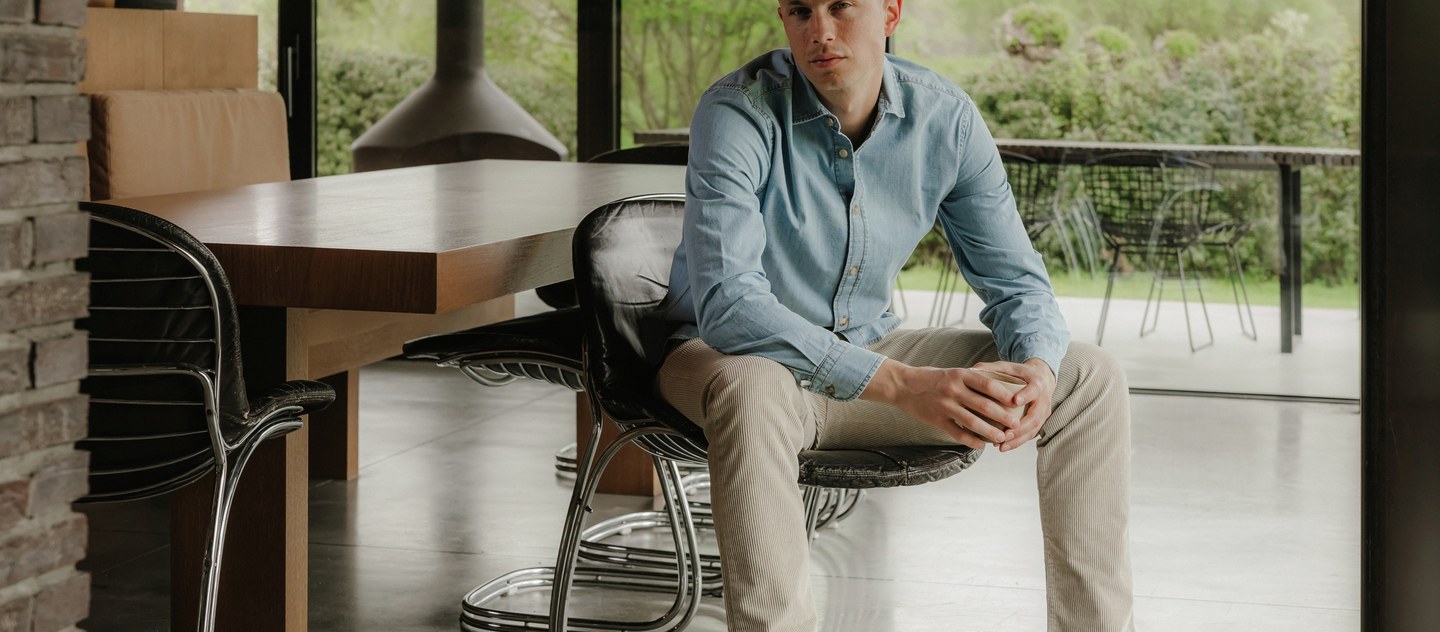
A pair of chinos looks simple. Perhaps that is precisely why it is so difficult to make a really good pair of chinos. We’d like to tell you what we at Atelier Noterman call a ‘good pair of chinos’, and where the challenge lies.
Unlike jeans, chinos don’t have a distinctive denim wash that can hide minor imperfections. Nor do they have a heavy weave that naturally gives the trousers character. Nor are chinos formal suit trousers, where the silhouette is almost entirely determined by tailoring. Chinos sit somewhere in between. They must be smart enough to wear with a shirt or blazer, yet relaxed enough for a T-shirt or jumper. They must be soft and comfortable to wear, whilst retaining their shape. They must look modern without becoming dated after just one season.
At Atelier Noterman, it’s no coincidence that we call the chino an all-rounder. A good pair of chinos must be able to straddle the line between casual and smart.
What exactly are chinos?
Nowadays, the word ‘chino’ is mainly used to refer to a specific type of trouser, but originally it also referred to the type of woven fabric used to make such trousers. A classic chino fabric is usually a woven cotton fabric with a twill weave. This weaving technique creates a subtle diagonal pattern in the fabric. Denim is also typically woven using this twill weave. Nevertheless, chinos and jeans are not synonyms. With denim, the characteristic indigo dye, the contrast between the different threads and the way the fabric ages with wear are key elements of its character. Chinos generally look smoother, more uniform and more refined. But even within the world of chinos, there are significant differences. And one of these is particularly defining.
Not every pair of chinos is coloured in the same way
When you lay two pairs of chinos side by side, they may look very similar at first glance. Yet the way they are made can be fundamentally different.
At Atelier Noterman, we work according to two key principles. On the one hand, there are chinos made from fabric that is already coloured. The roll of fabric is therefore supplied in the chosen colour. The trousers are then cut from that coloured fabric and made to measure. Depending on the desired result, the finished trousers may then undergo a washing treatment. On the other hand, there are ready-to-dye fabrics. In this case, we start with an undyed or white fabric. First, the trousers are fully assembled. Only then are the finished trousers dyed.
That difference in sequence may sound technical. But it has a major influence on how a pair of chinos looks and how they evolve over the years.
‘Pre-dyed’ chinos are more even in colour and more colourfast
When we start with fabric that has been pre-dyed, the desired colour is already present in the fabric before the trousers are made. This usually produces a cleaner and more even result. The colour looks sharper and the trousers more easily achieve the smart look that many men expect from a pair of chinos.
An additional advantage is colour fastness. This is particularly relevant for darker shades such as dark blue and black. Anyone looking for chinos whose colour needs to remain crisp and even for as long as possible will often benefit from a fabric that has been pre-dyed.
That doesn’t mean such trousers don’t change at all. We must be honest about that too. Every fabric is worn, washed and exposed to light and friction. But the starting point is different: we aim to preserve a neat, consistent colour for as long as possible.
Ready-to-dye: more character and a casual look
With ready-to-dye chinos, the process is slightly different. Here, we first make the trousers from an undyed fabric. The seams are already in place. The pockets have been sewn on. The waistband has been made. The trousers have their final shape. The entire garment is then dyed. This is also known as garment dyeing: it’s not the individual pieces of fabric that are dyed, but the finished garment itself, which gives us a different result. Because the dye acts on the trousers as they are at that moment – including seams, edges and construction details – this dyeing process contributes to a slightly looser, sportier and more casual look.
Why do some chinos fade differently?
Ready-to-dye chinos will generally fade more noticeably with wear and washing. The colour evolves. Over time, subtle colour differences may become visible at the hems, seams and areas subject to more friction. This isn’t necessarily a quality issue. It’s part of the character we aim to achieve with these trousers.
A good comparison might be with leather or denim: some materials and treatments are chosen precisely because we appreciate that they take on a more personalised look with use. Something similar applies to ready-to-dye chinos. Anyone expecting a pair of black chinos to retain exactly the same even shade of black after dozens of washes as they did on day one might therefore be better off choosing a different type of fabric. Those who prefer slightly sportier trousers that develop more character through wear may find that very evolution appealing.
Colour fastness is therefore not automatically the same as quality.
The question is, once again: what result do we want to achieve?
Smart or more casual? Both can work well
This distinction is important because, when it comes to quality clothing, consumers sometimes automatically expect a fabric to change as little as possible. But that isn’t always the aim. Chinos made from pre-dyed fabric may be deliberately chosen because we want to create smart, refined trousers that retain their colour as well as possible. A ‘ready-to-dye’ fabric may be deliberately chosen because we’re actually looking for a softer, sportier and more worn-in look. One method isn’t necessarily better than the other. They’re simply different tools.
The fabric also helps determine how the chinos feel
As well as the way the trousers are dyed, the composition of the fabric naturally plays an important role too. Many chinos are made mainly from cotton. But 100% cotton isn’t automatically the best choice for every pair of chinos.
We see this in our own collection too.
Depending on the style and season, we use fabrics such as:
- 97% cotton and 3% elastane
- 99% cotton and 1% elastane
- 98% cotton and 2% elastane
- 59% cotton, 38% lyocell and 3% elastane
- 65% linen, 34% cotton and 1% elastane
These differences are not arbitrary. We start with the trousers we want to make. How should they drape? How soft should they feel? How much freedom of movement do we want? Which season are they intended for? Should they look more smart or sporty? And how do we want them to evolve after frequent wear? Only then do we move on to choosing the fabric.
Why do chinos contain elastane?
We’re sometimes asked why we always add elastane to the cotton. Our answer is actually very simple: because a man isn’t standing still when he’s wearing trousers. He sits. Walks. Cycles. Drives. Bends over. Climbs stairs. And whilst doing so, he’d rather not constantly feel that his trousers are restricting his movement.
A small amount of elastane can therefore make a big difference to the comfort of a woven fabric. That doesn’t mean that more stretch is automatically better. Just as with our jeans collections, we look for a balance. A pair of chinos must be able to give way where necessary, but shouldn’t feel like a pair of sports trousers. The fabric must also have sufficient resilience to support the trousers’ silhouette.
That’s why the percentage of elastane on the label never tells the whole story.
Is 99% cotton and 1% elastane better than 97% cotton and 3% elastane?
Not necessarily. It’s not quite that simple. It mainly indicates that the fabrics are constructed differently. A fabric with 1 per cent elastane might offer just the right amount of freedom of movement for a particular pair of chinos. A different construction might need 2 or 3 per cent to achieve the comfort we’re looking for. The weight, the yarns used, the weave density, the finish, and the way the trousers are dyed and washed all influence the final result. That’s why, at Atelier Noterman, we don’t believe in a single ‘ideal’ composition for every pair of chinos. The better question is: does this fabric do what these trousers need to do?
And why do we sometimes use lyocell?
For certain chinos, we use a fabric that combines cotton with lyocell and a small amount of elastane. Lyocell is a cellulose-based fibre and can give a fabric a different suppleness and feel to the touch than cotton alone. For a fabric maker, such a combination therefore opens up new possibilities. Trousers that need to drape softly and smoothly require something different from a fabric than a sturdier, sportier style. And that is precisely why we prefer not to talk about ‘the Noterman chino fabric’. It doesn’t exist. We use different fabrics because we want to be able to make different trousers.
Sometimes linen is the right choice
For other styles, we use a blend of linen, cotton and a small amount of elastane. This, too, creates a completely different character. Linen naturally has a livelier appearance and works particularly well with trousers that are meant to have a summery, more relaxed look. They can be a little more casual. It doesn’t need to have the same smooth surface as a classic cotton chino. But once again, we look at the overall combination. How do the trousers drape? How does the fabric feel? What happens when someone sits down? How does the material complement the desired look? And how can we ensure sufficient comfort?
So we don’t choose a fabric simply because ‘linen’, ‘lyocell’ or ‘stretch’ sounds appealing on a label. It has to add something to the trousers.
The weaver is just as important as the percentage of cotton
Moreover, if you only look at the care label, you’re missing a significant part of the story. Two fabrics both labelled ‘98% cotton, 2% elastane’ need not be the same at all. The quality of the fibres, the yarns, the spinning method, the weave construction, the density, the dyeing and the finishing all combine to determine how a fabric ultimately performs.
That is why we also consider it important who manufactures our fabrics. For various chino qualities, we work with specialist European weaving mills such as Olimpias and Tessuti di Sondrio, amongst others. We do this not because the name of a well-known supplier automatically guarantees that every pair of trousers is of high quality, but because we want to be absolutely certain about who we’re working with and where our materials come from. This brings us back to the Noterman family’s mission:
Atelier Noterman guarantees quality: stylish trousers that you can literally turn inside out. We’re proud of the fair, transparent and sustainable way in which they’re made. A fair deal for everyone – that’s what drives us, day in, day out.
Even good fabric can still result in a poor pair of chinos
Back from our mission to our J trousers. Because there’s still so much more to say about those trousers. Even the best roll of fabric doesn’t automatically result in a good pair of trousers. After all, that’s when the making begins. How is the pattern constructed? How do the trousers fit around the seat? How much room is there around the thigh? How does the leg run? How is the waistband constructed? Where are the pockets placed? How are the seams finished? And how do the trousers hold up when someone isn’t just trying them on for five minutes, but wears them for a whole day? With chinos, those details are perhaps even more important because there are relatively few visual distractions.
‘A simple pair of trousers is unforgiving.’ We used to hear that from our father all the time. And he’s right, of course. You can see a pocket that’s in the wrong place. You can see a poor fit. You can see fabric that starts to sag around the knees. You can see an imprecise seam. That’s why the difficulty in making a good pair of chinos often lies precisely in everything that seems simple at first glance.
Feel free to turn our chinos inside out
That principle doesn’t just apply to our jeans. We say that you should literally be able to turn a pair of Atelier Noterman trousers inside out. Because the inside tells a story that remains largely hidden on the outside. How are the seams finished? What does the waistband look like? How are the pockets constructed? What linings are used? Where are the reinforcements? How much attention has been paid to parts that a manufacturer knows full well most customers will hardly ever look at?
For us, all of that is part of quality. But we also mean ‘turning inside out’ in a figurative sense. We don’t just want to show how a pair of chinos is made. We also want to show as much as possible what they’re made of.
That’s why we even publish the cost of our fabrics
On our website, we disclose the ingredients of our trousers. Where possible, we list not only the composition, but also the supplier, the country of origin or manufacture, and the cost price.
We do this for fabrics, but also for zips, buttons, thread, labels and other components. And wherever possible, we even disclose the manufacturing costs. All this information shows exactly what makes up the price of a garment.
This is important to us.
A pair of trousers involves much more than just materials.
A pair of chinos isn’t made by just one company. There are people who produce cotton, linen or cellulose fibres. People who make yarns. Weaving mills that produce fabrics. Companies that dye and finish fabrics. Manufacturers of buttons and zips. Pattern-makers. Cutters. Seamstresses and stitchers. People who dye and wash trousers. Transporters. Retailers.
Every link in the chain adds value. And that brings us to a word that is important within our family: fairness.
A good pair of chinos must also be fair chinos
We believe that everyone who adds meaningful value to a pair of trousers should be fairly remunerated for their work. That sounds simple, but in a clothing sector where there is constant pressure on prices, it is by no means a given. That is why we consider such far-reaching transparency to be so important. If you don’t know where your fabric comes from, who makes your trousers and roughly how much the various components cost, it becomes extremely difficult to have a serious discussion about a fair price.
For us, fairness does not mean that every pair of trousers must be as cheap as possible. Nor does it mean that a high retail price is automatically proof of good business practice or sustainability. It means that we try to understand where value is created and where the money ends up.
Does a more expensive pair of chinos automatically mean they’re better?
No. That, too, would be too simplistic. You can find a well-made and comfortable pair of chinos for less money. And an expensive logo doesn’t make a poor-quality pair of trousers any better. Price and quality aren’t the same thing. But if you only compare the final price, you’re not seeing the full picture either.
Perhaps you now understand why we share so much information on our website, in our blogs and in all our other communications. We’re proud of our trousers and the price at which we offer them to you. What’s more, everyone has the right to know the answers to questions such as: What fabric was used? How was it dyed? Was it a ready-to-dye quality or was the fabric pre-coloured? Which supplier did it come from? Where was it woven? What raw materials does it contain? Where were the trousers made? Who made the zip and the buttons? How much work went into them? And how much do the various links in the chain earn?
These are questions that are difficult to fit onto a single price tag. But they do help determine the true value of a pair of trousers.
So how do you recognise a good-quality pair of chinos?
That was the fundamental question of this blog. We’ve tried to formulate our answer as thoroughly and honestly as possible. But perhaps this doesn’t make it any easier. So, to conclude, here are a few practical tips: Don’t just look at the label. Feel the fabric. See how it drapes. Try the trousers on and have a sit down. Move around. Check how the waistband fits. Examine the pockets and seams. Turn the trousers inside out and pay attention to the details. Ask how the trousers were dyed if colour fastness is important to you. But above all, give them time. Because, just like with jeans, the true quality only becomes apparent when you wear them. How do they feel after a full working day? What do the knees look like after you’ve been sitting for hours? Does the fabric retain its shape? How does the colour develop? Do the seams hold up well? And after dozens of wears and washes, do you still enjoy putting the trousers on?
Do you now understand why, at Atelier Noterman, we want to be known as the maker of stylish trousers that you can literally turn inside out?
Literally, to see how they’re made. But also figuratively, to discover which fabric was chosen, how the trousers got their colour, where the components come from, who worked on them and what those components cost.
Because for us, a good pair of chinos isn’t just a nice pair of cotton trousers. It’s the sum of material, colour, craftsmanship, comfort, transparency and fairness.